
.jpg)





.png)



.png)

.png)


.png)
.png)





.avif)







.png)
===== PAGE 1 =====
Krakow IT Market Report
IN PARTNERSHIP WITH
2026 Krakow IT Market Report 1
192
===== PAGE 2 =====
STRATEGIC PARTNER
MAIN PARTNER
INSTITUTIONAL PARTNERS
CORPORATE PARTNERS
COMMUNITY PARTNERS
EXPERTISE PARTNERS
MEDIA PARTNER
2026 Krakow IT Market Report 2
192
===== PAGE 3 =====
Intro 4
Michał Piątkowski, CEO MOTIFE 5
Aleksander Miszalski, Mayor of Krakow 6
Przemysław Roth, Chairman of ASPIRE 8
Key findings 12
Krakow IT market snapshot 14
Why Krakow? 15
Krakow's IT talent pool 17
Krakow as an AI hub 18
Krakow's IT talent pool 32
Large companies 40
Dual Use and Space 67
Industries 74
International unicorns in Krakow 84
Content
Start-ups 86
Education and science 93
Public institutions 100
Communities 104
Tech events 108
Office space in Krakow 114
Hiring in Poland 124
IT talent pool in Poland 125
Salaries 130
Employment and benefits 145
How to recruit IT talent in Poland? 152
How to employ IT talent in Poland? 157
Cost of doing business in Poland 166
Key figures 167
Employment cost 170
Professional services 172
Taxes in Poland 173
Incentives and support programs in Poland 175
Office market in Poland 181
About MOTIFE 189
2026 Krakow IT Market Report 3
192
===== PAGE 4 =====
Intro
2026 Krakow IT Market Report 4
192
===== PAGE 5 =====
Intro
Michał Piątkowski
CEO at MOTIFE
My bet is that we will need more IT specialists, not fewer. But the profile of those specialists will change. The market will reward people who can combine technical depth, product thinking, domain expertise, and the ability to use AI as an engineering tool rather than a novelty.
Krakow's IT talent pool grew by 5% over the past year and has now reached 65 000 specialists. That is roughly 40% more than in 2021. IT specialists now account for almost 12% of everyone employed in the city.
Krakow is already adapting. The city is also building momentum in the space sector and paying more attention to dual-use technologies. These - together with AI - are the foundations of the next phase of Krakow's development as a technology hub.
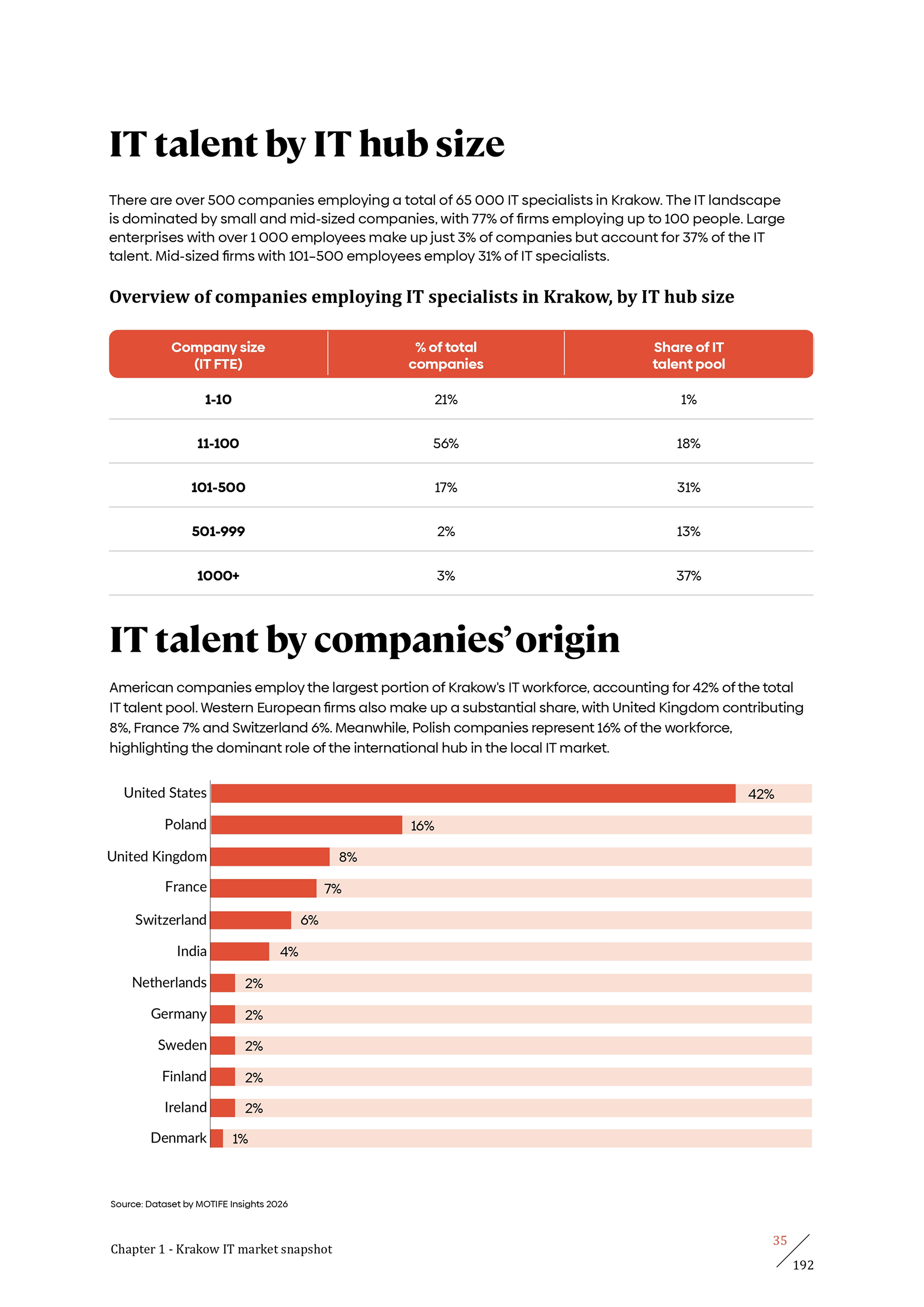
These numbers are not estimates pulled from a distance. Each year, we map Krakow's IT employer base company by company. The picture is clear: Krakow remains one of Europe's most international technology hubs. US companies employ 42% of local IT talent, Polish companies 16%, and French companies 7%, making France the largest EU contributor. Our research also shows that salaries have stabilized. Hiring a new IT specialist is now 1-2% cheaper than a year ago.
Then there is AI.
There is also a more strategic question to face. Around 80% of Krakow's IT specialists work for non-Polish employers. This has been a major strength. International companies helped make Krakow globally relevant. But such concentration also deserves attention. The next stage of the ecosystem should include not only more international investment, but also stronger Polish technology companies.
AI will change the skills expected of IT specialists. It will push universities to redesign parts of their curricula. It will increase the amount of software that companies build. But the deeper question is still open: how will AI change the structure of the IT industry itself?
I am proud to present the 2026 edition of the Krakow IT Market Report. Thank you to the MOTIFE team, our partners, and all contributors who made this report possible.
2026 Krakow IT Market Report 5
192
===== PAGE 6 =====
Intro
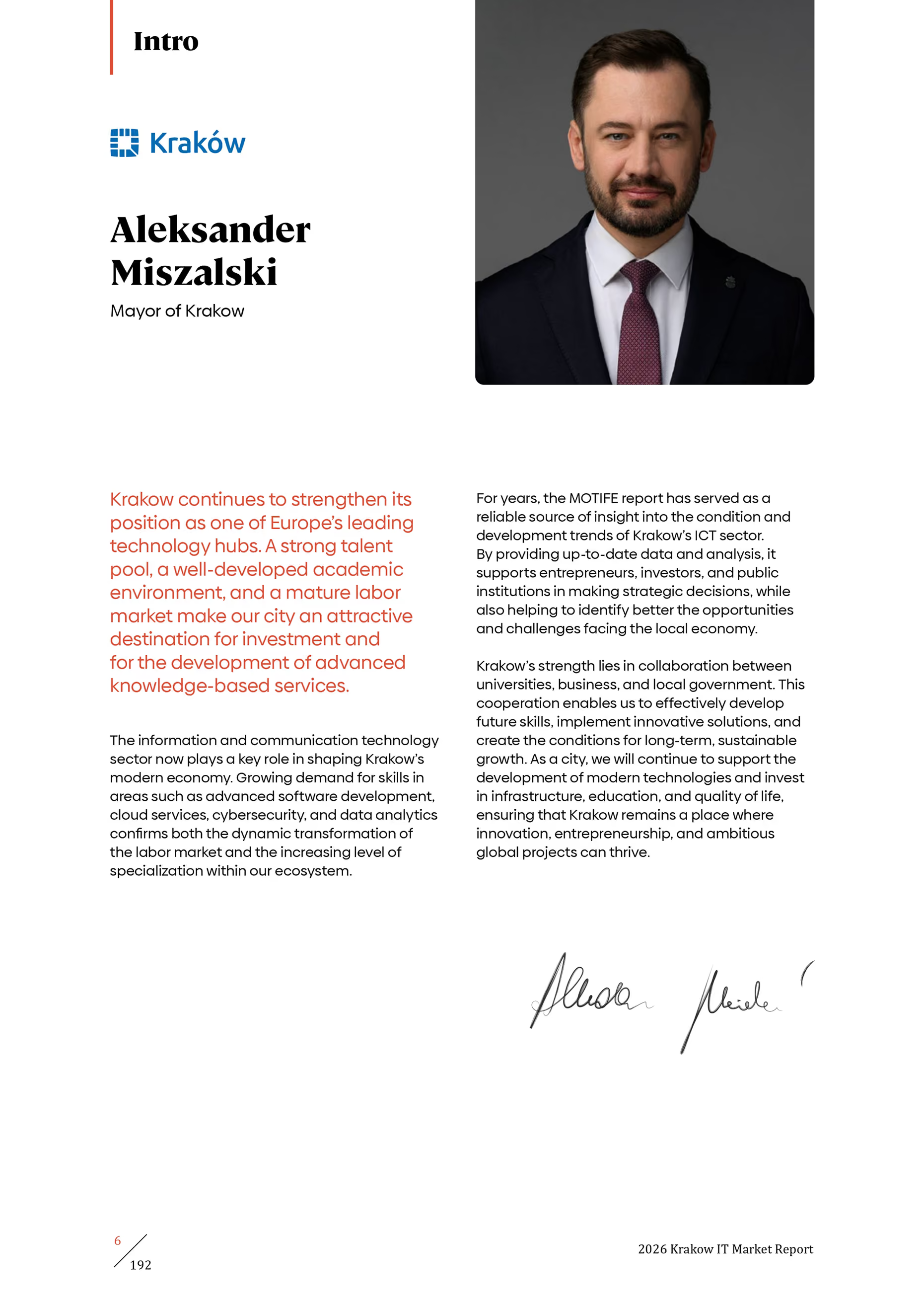
Aleksander Miszalski
Mayor of Krakow
For years, the MOTIFE report has served as a reliable source of insight into the condition and development trends of Krakow's ICT sector. By providing up-to-date data and analysis, it supports entrepreneurs, investors, and public institutions in making strategic decisions, while also helping to identify better the opportunities and challenges facing the local economy.
Krakow continues to strengthen its position as one of Europe's leading technology hubs. A strong talent pool, a well-developed academic environment, and a mature labor market make our city an attractive destination for investment and for the development of advanced knowledge-based services.
Krakow's strength lies in collaboration between universities, business, and local government. This cooperation enables us to effectively develop future skills, implement innovative solutions, and create the conditions for long-term, sustainable growth. As a city, we will continue to support the development of modern technologies and invest in infrastructure, education, and quality of life, ensuring that Krakow remains a place where innovation, entrepreneurship, and ambitious global projects can thrive.
The information and communication technology sector now plays a key role in shaping Krakow's modern economy. Growing demand for skills in areas such as advanced software development, cloud services, cybersecurity, and data analytics confirms both the dynamic transformation of the labor market and the increasing level of specialization within our ecosystem.
2026 Krakow IT Market Report 6
192
===== PAGE 7 =====
About Krakow
of professionals, with a strong concentration in IT, engineering, and advanced business services. As a result, the city has transitioned from a cost-oriented location to one defined by specialized competencies and operational maturity.
Krakow's academic base underpins this model. The city hosts 17 universities and higher-education institutions educating more than 120 000 students annually. Close cooperation between academia and industry supports a steady talent pipeline and applied research.
Krakow is Poland's second-largest city and the economic and academic center of the Malopolska region. With a metropolitan population of around 1.5 million, it plays a structural role in the country's economy and serves as one of its most internationally embedded urban markets.
Located in southern Poland, Krakow sits at the intersection of Central and Western Europe. The city is well-connected to major European business hubs via its international airport. It benefits from a time zone that enables smooth collaboration across Europe and a partial overlap with North America. This geographic positioning supports Krakow's role as a coordination point for distributed international operations.
More recently, Krakow has strengthened its strategic position through artificial intelligence. The city is now part of the European network of AI factories and has been selected as one of two locations in Poland for this initiative. The Krakow AI factory, a specialized, high- performance data center infrastructure, supports AI research, model development, and industry collaboration, positioning the city as an emerging node in Europe's AI ecosystem.
Over the past 25 years, Krakow has developed into a knowledge-driven economy. International companies have established shared service centers, R&D hubs, and centers of excellence employing tens of thousands
Tri-City
Poznan
Population of Krakow Metropolitan Area 1.5M
Warsaw
Lodz
Wroclaw
Katowice
Krakow
Largest city in Poland 2nd
Sources: krakow.stat.gov.pl, krakow.pl, 2026
2026 Krakow IT Market Report 7
192
===== PAGE 8 =====
Expert view
Przemysław Roth
Chairman at ASPIRE
Krakow has become something that very few European cities have managed to build - a technology and business services ecosystem of genuine scale and genuine depth, one in which many of the largest global companies have chosen to locate and grow operations through successive cycles of economic pressure and strategic change.
And the ecosystem it has generated is not a fixed thing. It has evolved through the choices and commitments of the organisations operating within it, which is precisely why the intelligence those organisations are willing to share about themselves and their market is so valuable. Reports like this do not produce themselves. The organisations and individuals who contribute data and expert assessment do so because they understand that honest, shared intelligence is a community asset - and that a city willing to interrogate itself honestly has moved to a different stage than one that simply promotes itself.
The fullest praise must go to MOTIFE, whose knowledge of how international technology companies actually find their footing in this city gives this report its particular authority - and who have grown it, over 7 editions, into something this market can rely on.
Of course, if you are reading this, then the chances are this is something you already know. The question you are looking to answer is rather how is Krakow placed for the next wave of change and transformation - in particular, how ready is Krakow to meet the challenge and opportunity of AI. In which case you have come to the right place, and it is why this report this year is especially timely. The short answer to the question is positive; the long answer contained in the pages of this report is the proof.
The key finding of the report - beyond the impressive numbers, beyond let's say the traffic light signals - is the rich complexity of the IT ecosystem in Krakow, some areas mature, some less mature, but existing in a constant state of emergence. That complexity is not a problem to be managed. It is what a living ecosystem looks like - and it is, in the end, the true measure of a place.
Technology is everywhere. Advantage is local.
To understand what lies behind this, you have to start with the connection between Krakow's IT market and its global business services base. GBS has been the mechanism by which enterprise technology, automation, data capability and digital transformation entered this city and became local competence. That transformation continues - it remains the most important driver of what comes next.
2026 Krakow IT Market Report 8
192
===== PAGE 9 =====
ASPIRE - Association of IT and Business Services Companies
ASPIRE is the association of technology and business services companies operating in Krakow. It is the network that the ecosystem has built around itself - the shared intelligence, the peer exchange, the institutional memory of two decades of multinationals growing, competing, and evolving in this city. ASPIRE does not speak about the market from outside. It is constituted by the people who run it.
aspire.org.pl
2026 Krakow IT Market Report 9
192
===== PAGE 10 =====
Focus Economic update
Regional leader, now a trillion-dollar economy
Poland has crossed a defining threshold: with nominal GDP of USD 1.04 trillion in 2025, it is now the 6th-largest economy in the European Union and the undisputed regional leader in Central and Eastern Europe.
Stability and resilience
Regional leader
Since joining the EU in 2004, Poland has averaged 3.8% real GDP growth per year for 22 consecutive years - nearly 3x the EU-27 average of 1.4%.
Poland's GDP is 2.5x the size of Romania - the next-largest CEE economy - and roughly equal to Romania, Czechia, and Hungary combined. For Western firms evaluating nearshore destinations, this scale translates into deeper talent pools, more mature service-provider ecosystems, and greater operational resilience than smaller CEE markets can offer individually.
Poland has weathered the recent shock cycle - bringing CPI inflation down to 3.0% in March 2026, and continuing to grow. GDP grew 3.6% in 2025, with the forecast of 3.5% in 2026 - outpacing the EU average. This resilience is underpinned by a diversified industrial base, a flexible exchange rate, and Next Generation EU funds now flowing into public investment through the remainder of the decade.
Average annual real GDP growth, 2004 to 2025 3.8%
Quality of life
Poland's nominal GDP, 2025 USD1.04T
The economic changes had significant influence on society. Poles have experienced a notable improvement in the quality of life over the past decades. This progress is reflected not only in rising GDP per capita, but also in significant investments in infrastructure, education, and public services. Poles generally report higher levels of life satisfaction, particularly among younger generations.
Poland has absorbed roughly 1 million Ukrainian refugees since 2022 with a net-positive fiscal contributions. Over the same period, Russian gas was eliminated from the energy mix, replaced by supplies from Europe (specifically EEA) and expanded LNG capacity, while trade flows have reoriented toward Germany, the US, and Nordic partners.
The Polish Złoty continues to remain stable against the Euro: daily rates have traded in a tight 4.13 to 4.40 band since the start of 2024 - a ~6% range and the most stable period in over a decade.
Rank of Poland in Europe by life satisfaction index 12of37
Source: ec.europa.eu, stat.gov.pl
2026 Krakow IT Market Report 10
192
===== PAGE 11 =====
Size of CEE economies (2025)
Quality of life: life satisfaction index
< 76
76 - 83
83 - 86
86 - 89
>= 89
Source: ec.europa.eu/regional_policy/information-sources/maps/quality-of-life_en
2026 Krakow IT Market Report 11
192
===== PAGE 12 =====
Key findings
Growth of the talent pool
65K total in Krakow 5% up YoY
Krakow's IT talent pool has reached around 65 000 specialists, up 5% year over year, driven by both companies' expansion and steady influx of new market entrants.
ICT graduates
2.9K ICT graduates 30% up in 5 years
Krakow's academic pipeline produces around 2 900 Computer Science graduates annually, with the number of ICT students in the city growing by 30% over the past five years.
Cisco
Largest IT employer
US-originated Cisco, specializing in networking products, ranks as the largest single IT employer in Krakow, hiring 2 150 IT specialists among the total headcount of 6 500 people.
250+ in Krakow
International companies
International companies play a leading role in Krakow's tech scene, employing 84% of IT talent, led by U.S. firms (42%) and supported by a strong European presence (34%).
42% from the US 7% from France (top EU)
Top countries employing IT talent
The United States leads Krakow's IT market, employing 42% of the talent pool. France is the top EU contributor, with 7%, ranking 4th overall after the United States, Poland and the UK.
2026 Krakow IT Market Report 12
192
===== PAGE 13 =====
12 in the last 12 months
New international IT players
Krakow keeps attracting international companies to settle their IT hubs here. The influx of new companies has stabilized at the level of around 10 - 15 companies a year in the past 2 years.
10 emerged industry clusters
Industry clusters
These sectors employ approximately 43 000 IT specialists, representing 66% of the city's total talent pool and underscoring the strong concentration of expertise across key industries.
Salaries and demand
New hires cost on avg 1-2% less 6% attrition
New hires declined by 2% for senior roles and by 1% for mid level specialists - to 17 000 PLN (~4 000 EUR). The attrition level in Krakow companies remained stable at 6%.
AI, Dual Use, Space, and Startups
City's innovation pillars
Krakow's refreshed innovation perspective is based on pillars such as AI, dual-use technologies, and the space sector, supported by initiatives including FORT DIANA, the AI Factory, and the Startup Poland Foundation.
2026 Krakow IT Market Report 13
192
===== PAGE 14 =====
Chapter 1
Krakow IT market snapshot
2026 Krakow IT Market Report 14
192
===== PAGE 15 =====
This chapter explores Krakow as a dynamic and growing tech hub, highlighting its skilled IT talent pool, established companies, emerging players, and expanding startup scene. It also offers insights into the city's academic institutions, active tech communities, and events landscape, as well as the evolving office market that supports business growth.
Why Krakow?
Krakow has become a top destination for international companies looking to grow their IT teams by establishing their own sites. Today, Krakow hosts over 250 international IT hubs, with more than 60 new international tech players having entered the market in the last five years. The following section outlines the reasons for Krakow to be a compelling location.
Proven business location
Exceptional IT talent pool
Established tech & business ecosystem
Scalability
The IT talent pool in Krakow grows each year. This growth is driven by recent graduates, international professionals, and people relocating from other parts of the country and from abroad.
Krakow hosts hundreds of software employers, including large international organizations such as Google, IBM and ABB as well as medium-size and smaller organizations across different industries, originating from over 30 countries. New IT players continue to open their hubs every year.
Maturity
Cost-effectiveness
More than 80% of IT professionals have over five years of experience. Most have worked with several international companies of different sizes and cultures.
Sophistication
Krakow offers a favorable cost-to-quality ratio for building IT hubs. Engineers in Poland earn, on average, 2.5 times less than their US counterparts. Salaries in Western European markets such as Germany and the UK also remain higher than in Poland. Beyond salaries, Krakow provides cost advantages in other key areas, including office space, utilities, and general business overheads.
Poland is a go-to location for hiring experts in niche tech roles, from software and DevOps engineers to data engineers, scrum masters, product owners, and UI/UX designers.
Supportive business environment
Quality
Each year, around 2 900 students graduate with ICT degrees. Combined with a strong STEM education system and the consistently high rankings of Polish engineers, Poland offers the quality of talent that is often unaffordable to companies in their home countries.
Cultural proximity
Krakow offers a business-friendly environment, supported by public institutions that promote investment and innovation, offering aid for companies entering the local market. Poland provides incentives encouraging foreign investment. R&D centers can benefit from the R&D tax relief, and businesses setting up operations in designated areas, such as the Special Economic Zones, may qualify for income tax exemptions under the Polish Investment Zone program.
Strategic location and connectivity
Polish professionals share a similar work culture with their Western European and North American counterparts, which makes international collaboration smoother. Shared values around communication, work ethics, and business practices help teams integrate quickly and work effectively across borders.
Situated in the heart of Central Europe, Krakow offers convenient access to major European cities through a well-connected airport and modern transport infrastructure. The city's location and time zone make it suitable for collaboration with teams in Europe and North America.
2026 Krakow IT Market Report 15
192
===== PAGE 16 =====
Expert view
Jacek Liguziński
Director of the Entrepreneurship and Innovation Department at Krakow Municipality
Why Krakow?
hubs. More than 50 000 professionals in the sector have over 10 years of experience, a unique characteristic that is difficult to find in any other European city.
A diversified, multi-industry IT ecosystem
Krakow's IT sector spans multiple industries, with strong presence in IT services, telecommunications, software, and finance, together employing over 75% of talent. At the same time, sectors such as travel, retail, manufacturing, and consumer goods drive demand for specialized, domain-focused IT expertise.
A strong office market
For years, Krakow has been strengthening its position as one of the most advanced economic ecosystems in Poland, combining a strong academic base with a rapidly growing business services, technology, and R&D sector. The city particularly stands out in terms of human capital - both employment potential and educational capacity. Krakow's quality of life, well-developed infrastructure, strategic location, and high availability and quality of office space have also long been key advantages. This is reflected in Krakow ranking 1st in the Human Capital and Lifestyle category in fDi Intelligence's European Cities and Regions of the Future 2025. A strong hub for modern business Krakow attracts investors as the home of numerous business centers and companies operating in the modern business services sector. The city hosts 312 business services centers, employing over 107 000 specialists, which represents 22% of the entire BSS workforce in Poland.
A mature market
Krakow is one of the most important and mature IT hubs in Poland, having completed the full cycle of industry development, from simple outsourcing services to advanced R&D centers, product development teams, and global decision-making
Krakow's office market is the largest regional office market in Poland, with 1.85 million m² of office space, representing over 14% of the country's total office stock. More than 420 000 m² has been delivered in the past five years alone, ensuring a modern, high-quality office portfolio. Krakow is one of the most attractive cities in Poland for business investment. The city's stable economic foundations and strong position as one of the fastest-growing technology and business services hubs in the country make it a welcoming destination for investors. Our ambition is to continue strengthening this potential and to create an environment where innovative companies can grow, compete globally, and scale successfully.
2026 Krakow IT Market Report 16
192
===== PAGE 17 =====
Krakow's IT talent pool Key figures
Estimated number of IT specialists working in Krakow region 65K
Computer Science students graduating yearly in Krakow 2.9K
Share of the IT talent pool employed by large, 1000+, IT hubs 27%
Share of Krakow IT specialists working in foreign companies 84%
Companies each employing 1 000+ IT specialists 10
Median salary of a mid- level software engineer with 3 to 5 years of experience (gross, monthly, nationwide) 4K EUR
Sources: MOTIFE Insights 2026, stats.gov.pl, 2026
2026 Krakow IT Market Report 17
192
===== PAGE 18 =====
Spotlight section Krakow as an AI hub
This section provides an overview of Krakow's evolving artificial intelligence ecosystem, covering local AI startups as well as international R&D teams developing advanced systems. It also highlights the city's active AI communities, and a significant recent initiative, the AI factory, which aims to strengthen Krakow's position as a key European center for AI development.
telecommunications, and robotics. This is complemented by strong adoption on the local side, with companies like InPost and Comarch applying AI in large-scale operations.
Krakow is emerging as one of the leading artificial intelligence hubs in Poland, combining a strong academic base with a rapidly evolving business ecosystem. Recognized in the national AI strategy as a key center, the city is strengthening its role in developing data-driven technologies and advancing AI adoption across industries.
The ecosystem is further strengthened by a growing startup scene supported by venture capital. Companies such as Skarbe, which secured $600K in pre-seed funding, and Replenit, which raised $2.5M for AI-driven marketing solutions, highlight the ability of Krakow-based teams to attract international investment.
Alongside them, AI startups like Airly, Intelliseq, and Orbify demonstrate strong specialization across climate tech, medtech, and geospatial analytics.
A key milestone in this development is the Gaia AI Factory, a project backed by nearly EUR 70 million (approx. EUR 16 million) in public funding and co-financed by the European Commission. The initiative will introduce a new AI-optimized supercomputer equipped with over 1 000 GPUs, enabling large-scale model training, testing, and deployment. The system is expected to deliver computing power several times greater than the existing Helios supercomputer, positioning Krakow as a critical infrastructure hub for AI development in Poland and the region.
Equally important is the role of local communities supporting collaboration and talent development. Organizations such as GenAI Krakow, Krakow AI Meetup, or Krakow Robotics & AI Club contribute to knowledge exchange and ecosystem growth.
At the same time, global technology leaders such as IBM, Google, ABB, and Ericsson continue to expand AI-related R&D activities in Krakow, spanning enterprise software, cloud computing,
Computing power of the Helios supercomputer at AGH Cyfronet 37PFLOPS
Of Krakow companies have AI software development tools officially deployed and integrated into their process, N = 23 78%
Source: Krakow Startup Report 2024, The state of AI in CEE 2024
Chapter 1 - Krakow IT market snapshot 18
192
===== PAGE 19 =====
Expert view
Dominika Walec
Plenipotentiary of the Mayor of Krakow for Business Cooperation
Krakow is entering a new phase of strategic acceleration-one in which AI becomes the defining layer of value creation.
The city's AI infrastructure is equally transformative. Cyfronet AGH, home to Poland's fastest supercomputers, is becoming a European‑level AI Factory, backed by EUR 70 million and focused on such areas as healthcare, space technologies, and large language models. Meanwhile, Cisco's new 4‑MW data‑center investment (200 million PLN) adds critical R&D capacity for AI, cloud, and sustainable computing - and signals strong corporate commitment to Krakow's innovation ecosystem.
Krakow's startup ecosystem, with 50+ AI startups and global‑scale innovators like Synerise, IntoDNA provides another engine of growth, with emerging synergies between founders and enterprise hubs. Cisco's startup‑focused initiatives only strengthen this alignment.
The city has exceptionally strong scientific and economic foundations, providing a powerful launchpad for AI-driven growth. At the same time, as highlighted in Anthropic's recent report by M. Massenkoff and P. McCrory, "Labor Market Impacts of AI: A New Measure and Early Evidence" (2026), real-world AI adoption still covers only a fraction of what is technically possible - indicating that the most significant wave of productivity gains is still ahead. This gap between potential and implementation creates a unique window of opportunity for cities like Krakow to position themselves at the forefront of applied AI transformation, leveraging both talent and institutional capacity.
Add to this the natural convergence with Krakow's high‑value sectors, life sciences, space, and dual‑use technologies, and the availability of large investment plots at Nowa Huta Przyszłości, ideal for data centers and next‑generation AI gigafactory infrastructure, and the city's trajectory becomes clear:
Krakow is uniquely positioned to lead this wave. With GBS workforce of 120 000 people, including more than 50 000 specialists with over a decade of process expertise, the city offers a concentration of talent capable of training AI systems and building value‑added digital solutions at scale. This evolution is already visible: Krakow hosts over 65 000 IT professionals and is shifting from delivery to strategic development across global organizations.
The vision is clear and executable: a city where world-class infrastructure, vertical sector expertise, and nearly 3 000 annual IT graduates converge into a self-reinforcing innovation engine - one that shapes European AI, rather than simply adopting it.
Chapter 1 - Krakow IT market snapshot 19
192
===== PAGE 20 =====
Focus AI factory in Krakow
The facility is intended to support researchers, public institutions, start-ups, and commercial users. Its priority areas include healthcare, space technologies, and large language models. It will also support the development of Polish-language AI models and their use in public services, strengthening Poland's digital autonomy and enabling more advanced AI applications in the public sector.
Krakow is set to strengthen its position as one of the leading AI hubs in Poland and Europe with the development of the Gaia AI Factory. Approved by EuroHPC JU in 2025, the project has a total budget of around EUR 70 million, financed jointly by the European Commission and the Polish government. It is being developed at the Academic Computer Centre Cyfronet at AGH University of Science and Technology, with full operations expected in 2026.
Gaia AI Factory will also strengthen Poland's position in the European AI infrastructure landscape. Through cooperation with institutions such as NASK, OPI, and other research and implementation partners, it is designed to connect computing infrastructure with research, commercialization, and public-sector use cases. The project is also aligned with the EU AI Act, with a focus on trusted, secure, and transparent AI systems.
The Gaia AI Factory will function as a high- performance computing platform for AI research and deployment. Its role is to provide the infrastructure needed to train, test, and scale advanced AI systems. The project expands Cyfronet's computing capacity beyond the Helios supercomputer and adds new AI-focused infrastructure equipped with more than 1 000 next-generation GPUs.
Source: cyfronet.pl, MOTIFE Insights 2026.
Chapter 1 - Krakow IT market snapshot 20
192
===== PAGE 21 =====
Expert view
Jarosław Królewski
CEO and Founder at Synerise
Krakow has evolved from a traditional outsourcing destination into one of Central and Eastern Europe's most important hubs for advanced data engineering and artificial intelligence development.
The rise of generative AI is accelerating this transition even further. Organizations are no longer treating AI solely as an experimental innovation area, but increasingly as a core business capability. This creates new opportunities for Krakow's technology sector, particularly because the region combines strong engineering talent, academic research capabilities, and international business experience.
In the coming years, Krakow is likely to strengthen its position not only as a delivery center for global corporations, but also as a place where advanced AI products and foundational technologies are created and developed at scale.
Over the last few years, the local technology ecosystem has increasingly shifted toward high- value competencies related to machine learning, cloud infrastructure, predictive analytics, and generative AI. This transformation is driven not only by global technology companies operating in the region, but also by locally founded firms building proprietary AI products and platforms with international ambitions.
One of the most visible changes in the IT market is the growing importance of data-centric architectures and real-time decision systems. Companies are investing heavily in technologies that allow them to process massive volumes of behavioral and operational data in order to automate business decisions, improve customer experience, and optimize internal processes. As a result, demand for specialists in AI engineering, MLOps, data infrastructure, and large-scale distributed systems continues to grow rapidly.
Chapter 1 - Krakow IT market snapshot 21
192
===== PAGE 22 =====
Selected large companies developing AI products in Krakow
Company Country of origin AI focus areas AI products/services summary
IBM USA Enterprise solutions
IBM's Poland Software Lab in Krakow is the company's first and largest innovation hub in Central and Eastern Europe, focusing on developing AI solutions for enterprise applications.
ABB Switzerland Robotics and automation
ABB's Corporate Research Center in Krakow specializes in industrial robotics and automation, advancing AI-enabled robots and machine learning for autonomous navigation.
Ericsson Sweden Telecommunications
Ericsson operates one of its largest R&D centers in Krakow, employing over 500 engineers to develop AI-driven solutions for 5G and telecommunications networks.
Aptiv Ireland Automotive
Aptiv in Krakow develops advanced mobility solutions, including AI- and machine learning- based systems for driver monitoring and intelligent vehicle technologies
Google USA Cloud AI, Infrastructure
Google's Krakow engineering team contributes to the development of AI-enabled cloud computing products and tools.
Motorola Solutions USA Public safety
Motorola Solutions' Krakow R&D center develops mission-critical communication and security technologies, including AI-driven video security and data analytics solutions.
InPost Poland Logistics
InPost uses AI for real-time logistics optimization, customer service, and document digitization, prioritizing practical, efficient solutions over complexity.
Nokia Finland Telecommunications, Networking
Nokia's Krakow technology center contributes to the development of next-generation telecom solutions, including AI-RAN and AI/ML tools supporting the evolution of 5G and 6G networks.
GE HealthCare USA MedTech
GE HealthCare's Krakow center focuses on developing AI applications for medical imaging and diagnostics to enhance patient care.
HERE
Technologies Netherlands Location services
HERE Technologies leverages AI to improve mapping and location-based services, with R&D operations in Krakow contributing to these advancements.
Source: MOTIFE Insights 2026
Chapter 1 - Krakow IT market snapshot 22
192
===== PAGE 23 =====
Expert view
Krystian Sperka
Vice President at Tenarai
When Tenarai opened its Krakow centre in 2020, we bet on a city known for technological excellence. Six years on, the results speak for themselves.
For a global retail brand, we used GenAI to build a defect-prevention platform that aggregates data from 25 sources into a single view of top defects, streamlining information flow and enabling smarter resource allocation. One of our largest successes was with a global logistics brand, helping them migrate from ETL graphs to PySpark notebooks using an automated tool, seamlessly moving 7+ years of data. By combining data lakes and data warehousing with Azure integration, our solution delivered 40% faster reporting and analytics, and increased data transformation efficiency by 30%.
Powered by Ignis, our proprietary AI platform, and our Agentic AI frameworks, we turn AI potential into measurable business impact, guiding enterprises from ideation to scale. Our AI & Cloud CoE supports 20+ global clients across travel, insurance, and technology with custom-built AI solutions that drive speed, productivity, and tangible business outcomes.
2026 is the year of Enterprise Scale Agentic AI. As we enter this future, our diverse, expertise-rich workforce in Krakow will take the lead. And we're growing!
Our Talent Acquisition Team is focusing on new- age roles such as Forward Deployed Engineer and Agentic Design Lead, which will be crucial to building an AI-ready workforce with local talent to power our global aspirations.
We walk the talk when it comes to AI implementations. For a travel tech company, we deployed an AI-supported customer assistant to automate insights and improve query resolution, reducing triage time by 50%, improving ticket deflection by 20%, and accelerating resolution time by 30%. A leading Food & Beverage brand achieved success with an AI-powered insight engine we built, leveraging NLP to surface consumer-brand data and deliver a holistic view that sharpened decision-making with actionable insights.
Chapter 1 - Krakow IT market snapshot 23
192
===== PAGE 24 =====
Selected Krakow start ups developing AI solutions
Company AI focus areas AI products/service summary
AILIS Medtech Developer of a non-invasive breast health monitoring system. This system uses Dynamic Parametric Imaging (DPI) and AI algorithms to detect changes in breast tissue.
Brainly Edutech Global peer-to-peer learning platform for students, now integrating AI as a personalized "AI learning companion" for homework help.
Synerise Marketing automation
AI-driven customer data platform for large enterprises - collects and analyzes behavioral data to automate personalized marketing, loyalty, and pricing in real time.
Lekta AI Customer service
Conversational AI solutions for customer support and business communication, combining LLM-based and neurosymbolic technologies to automate interactions and improve service quality.
Civer Computer vision
Developer of AI software for film restoration, video enhancement, and image upscaling, helping improve visual quality and automate post-production processes.
Digital First AI Marketing AI platform that automates creation of marketing strategies and ad content - analyzes company data and trends to generate campaign plans and copy, saving marketers time.
Elmodis Machine monitoring
Integrated hardware-software solution that uses AI to monitor industrial machinery performance and predict failures, improving operational efficiency.
Cardiomatics Medtech Cloud AI platform that automates ECG interpretation - detects ~20 heart abnormalities and generates diagnostic reports in minutes.
MedApp Medtech Developer of CarnaLife platform - FDA-approved software using mixed reality 3D holograms for medical imaging and AI analytics, plus a telemedicine system for remote patient monitoring.
Mentalio Medtech
Mentalio uses AI to support the early diagnosis of mental health disorders in children and adolescents, empowering kids, parents, and specialists to take control of emotional well-being through innovative technology.
Vivis Mind Medtech
Developer of a smartphone-based platform using voice analysis algorithms to detect and monitor cognitive disorders like dementia. Delivers results in under 5 minutes and integrates easily into existing medical workflows.
Source: MOTIFE Insights 2026
Chapter 1 - Krakow IT market snapshot 24
192
===== PAGE 25 =====
Use of AI tools in SDLC
This section is based on survey data collected from IT leaders representing 23 organizations operating in Krakow. The analysis focuses on how engineering teams are adopting AI in daily development work, what governance models are emerging, where measurable business value is observed, and what barriers companies face when scaling usage.
AI usage: adoption and organizational approach
I adoption in Krakow-based companies has largely moved beyond the experimental phase and become part of day-to-day operations. Most companies already use AI tools in their development processes, showing that AI is no longer a future capability, but a current operational standard.
Surveyed companies report that AI tools are integrated into development process. 78%
At the same time, organizational policies are still evolving, with many companies transitioning from individual experimentation toward more structured, company-wide adoption.
AI usage policy
26%
Mandatory (Developers are required to use specific AI tools)
30%
Voluntary (Developers may use AI tools at their discretion
43%
Transitional (Currently coluntary, but we plan to make it mandatory soon)
Source: MOTIFE Insights 2026, AI adoption in Krakow companies survey, 2026, N=23
Chapter 1 - Krakow IT market snapshot 25
192
===== PAGE 26 =====
Preferred AI models
The data shows a diversified AI landscape, with companies relying on multiple leading providers rather than a single dominant ecosystem. At the same time, the adoption of custom in-house models, proprietary solutions, and open-source tools remains relatively limited.
AI models
Open source or local models (e.g., LIama 3) 4%
Tools proprietary or native model (e.g. Cursor) 9%
I don't know / I use the tool's default 9%
Custom in-house model (A model trained or fine-tuned) 9%
OpenAI GPT 17%
Google Gemini 22%
Athropic Claude 30%
AI ROI by use case
The highest efficiency gains from AI are seen in routine, repeatable development tasks, particularly documentation, testing, and feature development. More complex areas such as refactoring, integration testing, and bug fixing show lower impact.
At the same time, a notable share of companies either does not track AI ROI or have not yet observed clear efficiency gains.
AI ROI by use case
Bug fixing and debugging 22%
Integration/E2E testing 26%
Refactoring and legacy code modernization 30%
New feature development (boilerplate logic) 48%
Unit testing 52%
Documentation generation 61%
Source: MOTIFE Insights 2026, AI adoption in Krakow companies survey, 2026, N=23
Chapter 1 - Krakow IT market snapshot 26
192
===== PAGE 27 =====
AI impact on task execution time
The data highlights a clear gap between optimistic expectations and the typical outcomes of AI usage. While some companies report significant gains in best-case scenarios, particularly in highly automated tasks, real-world results are generally more moderate.
In practice, companies most often achieve incremental efficiency improvements rather than transformational speedups, although a smaller group reports substantial productivity gains in selected use cases.
13%
15 hours (25x speedup)
43%
26%
10 hours (2x speedup)
22%
43%
5 hours (4x speedup)
22%
17%
2 hours (10x speedup)
4%
Source: MOTIFE Insights 2026, AI adoption in Krakow companies survey, 2026, N=23
Barriers to AI adoption
The main barriers to AI adoption are linked to risk, internal capabilities, and organizational readiness rather than cost alone. Security, compliance, and data privacy remain the biggest challenges, alongside knowledge gaps and concerns about AI reliability.
Overall, the key constraints are tied to trust, expertise, and the safe integration of AI into existing processes.
AI adaption barriers
Security, compliance or data privacy concerns 48%
Knowledge gap 43%
Quality concerns (hallucinations or bad code) 30%
Cost of tooling 26%
Team resistance 22%
Lack of management buy-in 13%
Chapter 1 - Krakow IT market snapshot 27
192
===== PAGE 28 =====
AI upskilling approaches
AI upskilling is primarily driven by internal and flexible learning formats, with companies focusing on continuous, accessible skill development rather than formal centralized programs.
Overall, organizations rely on a mix of internal knowledge sharing, self-paced learning, and vendor- supported training to build AI capabilities.
AI upskilling approaches
Internal knowledge sharing (brown bag sessions, internal workshops run by employees) 88%
Self-paced (Access to platforms like Udemy, Pluralsight or Coursera) 70%
Vendor-specific training (official training from Microsoft (Copilot), GitHub or other tool providers) 61%
External training (paid courses, conferences or certifications provided by vendors) 43%
None (employees are expected to upskill themselves) 4%
Source: MOTIFE Insights 2026, AI adoption in Krakow companies survey, 2026, N=23
Limitations of this research
This analysis is based on a relatively small sample size, which may limit the generalizability of the findings across the broader market. Additionally, the field of AI is evolving rapidly.
Tools, capabilities, and adoption patterns change quickly, meaning that some of the insights presented may become outdated in a short period of time.
Chapter 1 - Krakow IT market snapshot 28
192
===== PAGE 29 =====
Chapter 1 - Krakow IT market snapshot 29
192
===== PAGE 30 =====
Expert view
Konrad Bujak
Founder at CEE AI Hub
The community around generative AI in Krakow represents a structured and increasingly visible layer of the city's technology ecosystem, built around recurring events, academic institutions, and practitioner-led initiatives.
as AGH AI Days and AI for Science Krakow create regular interaction between researchers, students, and practitioners, ensuring that developments in generative AI translate into practical use cases. The AI ecosystem also extends into the broader developer community. Events such as "Build with AI" and local hackathons focused on generative models highlight an emerging builder culture, where experimentation and product development are central. This aligns with Krakow's position as a mature tech hub, where communities are closely linked with companies and startup networks. From an infrastructure perspective, national-level AI investments around AGH and Cyfronet further strengthen the ecosystem, providing long-term support for its development.
At the grassroots level, communities such as Krakow AI Meetup show consistent engagement, with over 600 members and regular in-person events attracting 70-90 participants. Alongside this, initiatives like GenAI Cracow indicate a more specialized, engineering-focused approach, covering areas such as LLM operations, data preparation, and multi-agent systems. This reflects a shift from general discussion toward building production-ready solutions.
the AI community in Krakow can be seen as a network of engineers, researchers, and founders connected through events, academia, and industry. While its exact scale is difficult to quantify, its consistency and institutional support indicate that it is becoming a stable and growing part of the city's tech landscape.